
Volvo XC90 2015-2026 Owners Manual / Starting and driving / Overheating of engine and transmission
Volvo XC90: Starting and driving / Overheating of engine and transmission
In certain driving conditions, such as driving in mountainous areas or hot weather, there is a risk of the engine or transmission overheating, especially when carrying heavy loads.
- Engine power may be temporarily limited.
- Remove any auxiliary lights mounted in front of the grille when driving in hot weather.
- If the temperature in the engine's cooling system becomes too high, a warning symbol will appear in the instrument panel along with the message Engine temperature High temperature Stop safely. Pull over to a safe location and let the engine idle for a few minutes to cool down.
- If the message Engine temperature High temperature Turn off engine or Engine coolant Level low, turn off engine is displayed, stop the vehicle and turn off the engine.
- If the transmission begins to overheat, an alternative gear shifting program will be selected. An integrated protective function will also be activated, the warning symbol will illuminate and the message Transmission warm Reduce speed to lower temperature or Transmission hot Stop safely, wait for cooling will be displayed in the instrument panel. Follow the recommendations given by reducing speed or stopping the vehicle safely and letting the engine idle for a few minutes to let the transmission cool.
- If the vehicle begins to overheat, the air conditioning may be temporarily switched off.
- After a prolonged period of driving in demanding conditions, do not turn off the engine immediately after stopping.
NOTE
It is normal for the engine's cooling fan to operate for a short time after the engine is switched off.
Symbols in the instrument panel
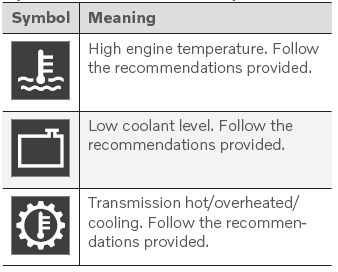
 Emission controls
Three-way catalytic converter
Keep your engine properly tuned. Certain engine malfunctions, particularly
involving the electrical, fuel or distributor ignition systems, may cause unusually
high threeway catalytic converter temperatures...
 Battery drain
The electrical functions in the vehicle drain the battery to varying degrees.
Avoid using ignition mode II when the engine is switched off. Use ignition mode
I instead, as this uses less electrical current...
Other information:
Volvo XC90 2015-2026 Owners Manual: Bulb specifications
Specifications for replaceable light bulbs. If you are experiencing problems with any lights other than light bulbs, contact a workshop1. If there is a problem with an LED2 light, the entire lamp unit will normally need to be replaced. A Watt 1 An authorized Volvo workshop is recommended...
Volvo XC90 2015-2026 Owners Manual: Emission controls
Three-way catalytic converter Keep your engine properly tuned. Certain engine malfunctions, particularly involving the electrical, fuel or distributor ignition systems, may cause unusually high threeway catalytic converter temperatures. Do not continue to operate your vehicle if you detect engine misfire, noticeable loss of power or other unusual operating conditions, such as engine over..
- Manuals Home
- 2nd Generation XC90 Owners Manual
- 2nd Generation XC90 Service Manual
- Arming and disarming the alarm
- Indicator and warning symbols
- Resetting the trip odometer
- New on site
- Most important about car
Categories
Driver/passenger side front airbags
As a supplement to the seat belts, the vehicle is equipped with driver and passenger side front airbags.
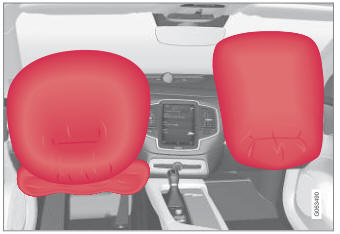
Driver/passenger side front airbags.

Copyright © 2026 www.voxc90.com