
Volvo XC90: Driver support / Using passing assistance
Passing assistance can be used with Adaptive Cruise Control* or Pilot Assist*. Several conditions must be met for passing assistance to be possible.
In order to activate passing assistance:
- your vehicle must be following a vehicle ahead (target vehicle)
- your vehicle's current speed must be at least 70 km/h (43 mph)
- the set speed must be high enough to safely pass another vehicle.
To start passing assistance:
- Turn on the left turn signal.
- Passing assistance will start.
WARNING
The driver should be aware that if conditions suddenly change when using Passing Assistance, the function may implement an undesired acceleration in certain conditions. Some situations should be avoided, e.g. if:
- the vehicle is approaching an exit in the same direction as passing would normally occur
- the vehicle ahead slows before your vehicle has had time to switch to the passing lane
- traffic in the passing lane slows down
Situations of this type can be avoided by temporarily putting Adaptive Cruise Control or Pilot Assist in standby mode.
* Option/accessory.
 Passing assistance
(Option/accessory.)
Passing assistance can assist the driver when passing other vehicles. The
function can be used with Adaptive Cruise Control* or Pilot Assist*...
 Collision risk warning from driver support
The driver support systems Adaptive Cruise Control* and Pilot Assist* can
help alert the driver if the distance to the vehicle ahead suddenly decreases to
an unsafe distance...
Other information:
Volvo XC90 2015-2026 Owners Manual: Messages in the center display
The center display shows messages in certain circumstances to inform or assist the driver. Example of message in the center display's Top view. Messages with lower priority for the driver are shown in the center display. Most of the messages are shown in the center display's status bar...
Volvo XC90 2015-2026 Owners Manual: Adding and editing timer settings for preconditioning
(Option/accessory.) The preconditioning timer can store up to 8 preset timer settings. Adding a timer setting Button for adding a timer setting in the Parking climate tab in Climate view. Open Climate view in the center display. Select the Parking climate tab...
- Manuals Home
- 2nd Generation XC90 Owners Manual
- 2nd Generation XC90 Service Manual
- Checking and filling engine oil
- Connecting a device via the USB port
- Indicator and warning symbols
- New on site
- Most important about car
Categories
Connecting equipment to the vehicle's data link connector
Incorrectly connected or installed software or diagnostic tools may have an adverse effect on the vehicle's electronics.
We strongly recommend that Volvo owners use only genuine, Volvo-approved accessories, and that accessory installations be performed only by a trained and qualified Volvo service technician. Certain accessories only work when the associated software is installed in the vehicle's computer system.
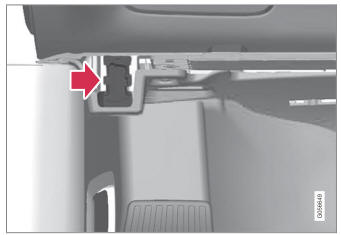
On-board Diagnostic (OBDII) socket under the dashboard on the driver's side.
