
Volvo XC90: Wheels and tires / Adjusting tire pressure
Tire pressure decreases over time, which is normal. The tire pressure must therefore be adjusted to maintain the recommended tire pressure.
Use the recommended inflation pressure for cold tires to help maintain good tire performance and even wear.
NOTE
To help prevent incorrect inflation pressure, pressure should be checked when the tires are cold. The tires are considered to be cold when they have reached the same temperature as the ambient temperature (about 3 hours after the vehicle was last driven). After driving for a few kilometers, the tires will warm up and the pressure will increase.
- Remove the valve cap from the tire and press the air pressure gauge firmly onto the valve.
- Inflate the tire to the correct inflation pressure; see the tire pressure placard on the driver's side B pillar for recommended pressures for factory-mounted tires.
- Screw the valve cap back on.
NOTE
- After inflating a tire, always replace the valve cap to help prevent valve damage caused by gravel, dirt, etc.
- Use plastic valve caps only. Metal caps could corrode and become difficult to remove.
- Visually inspect the tire to make sure there are no nails or other embedded objects that could puncture the tire and cause air leakage.
- Check the sidewalls to make sure there are no gouges, cuts, bulges or other irregularities.
- Repeat this procedure for each tire, including the spare tire1.
NOTE
If you have overfilled the tire, release air by pushing on the metal stem in the center of the valve. Then recheck the pressure with your tire gauge.
Some spare tires require higher inflation pressure than the other tires. Consult the tire inflation pressure table or the inflation pressure decal.
1 Not available on all models.
 Checking tire pressure
Correct inflation pressure helps improve driving stability, save fuel and
increase the service life of the tires.
Tire pressure decreases over time, which is normal...
 Recommended tire pressure
The tire pressure placard on the driver's side B pillar (between the front
and the rear door) indicates tire pressure for different loads and speed conditions...
Other information:
Volvo XC90 2015-2026 Owners Manual: Handling tiles in the center display
Home view consists of four tiles: Navigation, Media, Phone and a fourth tile. These views can be expanded. Expanding a tile from standard mode Standard mode and expanded mode of a tile in the center display. Expanding a tile: For tiles Navigation, Media and Phone: Tap the screen anywhere in the tile...
Volvo XC90 2015-2026 Owners Manual: Park Assist Pilot limitations
(Option/accessory. Park Assist Pilot (PAP1) may not be able to detect all conditions in all situations and functionality may therefore be limited. The driver should be aware of the following limitations for Park Assist Pilot. WARNING The parking sensors have dead/blind spots where objects cannot be detected...
- Manuals Home
- 2nd Generation XC90 Owners Manual
- 2nd Generation XC90 Service Manual
- Front fog lights/corner illumination
- Filling washer fluid
- Connecting the vehicle to the Internet via vehicle modem (SIM card)
- New on site
- Most important about car
Categories
Door and seat belt reminders
This system is intended to remind occupants to buckle their seat belts and to alert the driver if a door, hood or other opening (trunk, sunroof, etc.) is open.
Graphics in the instrument panel
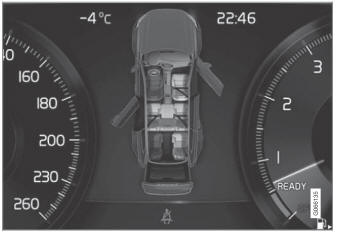
Graphics in the instrument panel with various types of warnings. The warning colors for the doors/tailgate vary depending on the vehicle's speed.
