
Volvo XC90: Starting and driving / Conditions for the Start/Stop function
Certain conditions must be met for Start/Stop to function.
If any condition is not met, this will be indicated in the instrument panel.
The engine does not auto-stop
The engine will not auto-stop if:
- The vehicle has not reached a speed of ca 10 km/h (6 mph) after starting.
- After several auto-stops, the speed must again exceed approximately ca 10 km/h (6 mph) before the next auto-stop.
- The driver has not fastened the seatbelt.
- The engine is not running at its normal operating temperature.
- The ambient temperature is under approximately -5 °C (23 °F) or over approximately 30 °C (86 °F).
- Windshield heating is activated.
- The climate system settings and the actual climate in the passenger compartment differ.
- The vehicle is in reverse.
- The driver is making large steering wheel movements.
- The road gradient is very steep.
- The hood is open.
- Driving at high altitude and the engine has not reached its normal operating temperature.
- ABS has been activated.
- Hard braking (even if the ABS system has not been activated).
- Many starts during a short period of time have triggered the starter motor's overheating protection.
- The exhaust system's particulate filter is full.
- A trailer is connected to the vehicle's electrical system.
- The transmission is not running at its normal operating temperature.
- The gear selector is in mode M (±).
- If traffic conditions allow it (for example in a traffic jam).
The engine does not auto-start
The engine will not auto-start after an autostop if:
The driver is not wearing a seat belt, the gear selector is in the P position and the driver's door is open. The engine must be started normally.
The engine auto-starts while the brake pedal is depressed
In the following situations, the engine will auto-start even if the brake pedal is depressed:
- High levels of condensation on the inside of the windows.
- The climate system settings and the actual climate in the passenger compartment differ.
- The brake pedal is pumped repeatedly.
- The hood is open.
- The vehicle begins to roll or increases speed slightly if the engine auto-stopped before the vehicle was at a standstill.
- The driver's seat belt is unbuckled with the gear selector in the D or N positions.
- The gear selector is moved from D to R or M (±).
- The driver's door is opened with the gear selector in D. An audible signal and a text message informs the driver that the ignition is on.
WARNING
Do not open the hood if the engine has auto-stopped. Turn off the engine by switching off the ignition before lifting the hood.
 Deactivating the Start/Stop function
In certain situations, it may be advisable to turn the Start/Stop function
off.
To turn off Start/Stop, tap the
Start/Stop function button in the center display's Function view...
 Leveling control and suspension
(Option/accessory.)
The vehicle's leveling control system adjusts the suspension and shock absorbers
automatically to help optimize comfort and control while driving...
Other information:
Volvo XC90 2015-2026 Owners Manual: Sun visors
In the ceiling in front of the driver's and front passenger's seats, there are sun visors that can be lowered and angled to the side as necessary. The illustration is generic – the design may vary. The mirror lighting* comes on automatically when the visor is lifted up...
Volvo XC90 2015-2026 Owners Manual: Whiplash Protection System
The Whiplash Protection System (WHIPS) is designed to help reduce the risk of whiplashtype injuries. The system consists of energy absorbing backrests and seat cushions as well as specially designed head restraints in the front seats. WHIPS is activated in the event of a rear-end collision and adapted to the angle and speed of the collision and to the characteristics of the colliding vehicle...
- Manuals Home
- 2nd Generation XC90 Owners Manual
- 2nd Generation XC90 Service Manual
- Indicator and warning symbols
- Jump starting using another battery
- Activating and deactivating child locks
- New on site
- Most important about car
Categories
Distance Alert
(Option/accessory.)
The Distance Alert function can help the driver become aware if the time interval to the vehicle in front is too short. The vehicle must be equipped with a head-up display* in order to display Distance Alert.
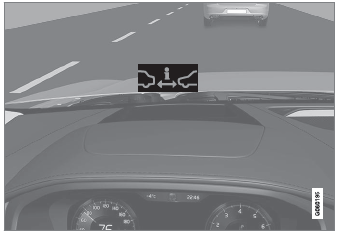
Symbol for Distance Alert on the windshield with head-up display
