
Volvo XC90 2015-2026 Owners Manual / Driver support / Connected Safety limitations
Volvo XC90: Driver support / Connected Safety limitations
Information on vehicles with activated hazard warning flashers or which have detected slippery road conditions is not always communicated between all vehicles in the affected area.
This may be the case if:
- No or insufficient Internet connection.
- The maneuvers (steering wheel movements, acceleration or braking) made by the vehicles on slippery surfaces are too weak for friction between the tires and road to be detected.
- Vehicles that have detected slippery road conditions or activated hazard warning flashers have not activated the function.
- Vehicles that have detected slippery road conditions or activated hazard warning flashers are not equipped with the function.
- Insufficient GPS/satellite navigation may prevent warnings.
- Slippery road conditions were detected or hazard warning flashers were activated on a road that is not registered in the Volvo Cars database.
- Connected Safety is not developed on all markets and does not cover all areas. Consult a Volvo retailer for more information on covered areas.
WARNING
- In certain situations, the function may give false warnings of slippery road conditions.
- The function cannot always detect other vehicles with activated hazard warning factors or detect all stretches of road with slippery conditions.
 Activating or deactivating Connected Safety
For Connected Safety to be able to share information about road conditions
with other drivers, the function must be activated. If you do not wish to share
information, the function can be deactivated...
 Road Sign Information
(Option/accessory)
The Road Sign Information (RSI1) function can help the driver observe
speed-related road signs.
Examples of signs that can be detected2...
Other information:
Volvo XC90 2015-2026 Owners Manual: Recommended tire pressure
The tire pressure placard on the driver's side B pillar (between the front and the rear door) indicates tire pressure for different loads and speed conditions. Location of the tire pressure placard The decal specifies the designation for the factory- mounted tires on the vehicle, as well as load limits and inflation pressures...
Volvo XC90 2015-2026 Owners Manual: Adjusting the rearview mirror dimming function
Bright light entering the vehicle from behind, e.g. from the headlights of following vehicles, could reflect in the rearview mirror and door mirrors and cause a glare. Use the dimming function when light from behind is distracting. Auto-dim If bright light enters the vehicle from behind, the door mirrors will automatically dim when it is dark outside or when lighting conditions are low, for exa..
- Manuals Home
- 2nd Generation XC90 Owners Manual
- 2nd Generation XC90 Service Manual
- Folding the second row backrests
- Active high beam
- Activating and deactivating the head-up display
- New on site
- Most important about car
Categories
Location and field of vision of Park Assist Cameras
The Park Assist Cameras (PAC1) can display a 360° panoramic view as well as separate views for each of the four cameras: rear, front, left and right.
360° view*
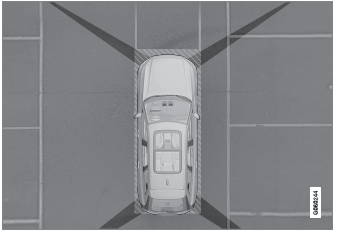
The location of the cameras and their approximate fields of vision.

Copyright © 2026 www.voxc90.com