Volvo XC90: Wheels and tires / Determining the vehicle's permitted weight
Properly loading your vehicle will provide maximum return of vehicle design performance.
Weight designations
Before loading your vehicle, familiarize yourself with the following terms for determining your vehicle's weight ratings, with or without a trailer, from the vehicle's Federal/Canadian Motor Vehicle Safety Standards (FMVSS/ CMVSS) label, and the vehicle's tire information placard:
Curb weight
The weight of the vehicle including a full tank of fuel and all standard equipment. It does not include passengers, cargo, or optional equipment.
Capacity weight
All weight added to the curb weight, including cargo and optional equipment. When towing, towbar weight is also part of cargo weight.
Permissible axle weight
The maximum allowable weight that can be carried by a single axle (front or rear). These numbers are shown on the Federal/Canadian Motor Vehicle Safety Standards (FMVSS/ CMVSS) label. The total load on each axle must never exceed its maximum permissible weight.
Gross vehicle weight (GVW)
The vehicle's curb weight + cargo + passengers.
Steps for Determining Correct Load Limit
- Locate the statement "the combined weight of occupants and cargo should never exceed XXX kg or XXX lbs." on your vehicle's placard.
- Determine the combined weight of the driver and passengers that will be riding in your vehicle.
- Subtract the combined weight of the driver and passengers from XXX kg or XXX lbs.
- The resulting figure equals the available amount of cargo and luggage load capacity. For example, if the "XXX" amount equals 1400 lbs. and there will be five 150 lb. passengers in your vehicle, the amount of available cargo and luggage load capacity is 650 lbs. (1400 - 750 (5 × 150) = 650 lbs.)
- Determine the combined weight of luggage and cargo being loaded on the vehicle. That weight may not safely exceed the available cargo and luggage load capacity calculated in Step 4.
- If your vehicle will be towing a trailer, load from your trailer will be transferred to your vehicle. Consult this manual to determine how this reduces the available cargo and luggage load capacity of your vehicle.
WARNING
- Exceeding the permissible axle weight, gross vehicle weight, or any other weight rating limits can cause tire overheating resulting in permanent deformation or catastrophic failure.
- Do not use replacement tires with lower load carrying capacities than the tires that were original equipment on the vehicle because this will lower the vehicle's GVW rating. Use only tires with the correct load carrying capacity. Consult your Volvo retailer for information.
 Inflate tires with the compressor included in the tire sealing system
The vehicle's original tires can be inflated using the compressor in the tire
sealing system.
The compressor must be switched off. Make sure that the switch is in the
0 (Off) position and take out the electrical cable and the hose...

Other information:
Volvo XC90 2015-2026 Owners Manual: Touching up minor paint damage
The paintwork is an important part of the vehicle's corrosion protection and therefore needs to be checked regularly. The most common types of paint damage are minor stone chips, scratches and damage to e.g. the edges of fenders, doors and bumpers. To help prevent corrosion, paint damage should be rectified immediately. NOTE Make sure the surface is clean and dry before performing any touch-ups..
Volvo XC90 2015-2026 Owners Manual: Replacing the high beam headlight bulbs
The high beam bulbs in the halogen headlights can be changed without the help of a workshop. Before the bulbs can be replaced, the plastic covering over the headlight must be removed. Before the lamp can be replaced, the rectangular headlight cover must be removed. CAUTION Never touch the bulb glass with your bare fingers. Grease and oils from your fingers vaporize in the heat and will leave a ..
- Manuals Home
- 2nd Generation XC90 Owners Manual
- 2nd Generation XC90 Service Manual
- Connecting the vehicle to the Internet via vehicle modem (SIM card)
- Front fog lights/corner illumination
- Checking and filling engine oil
- New on site
- Most important about car
Categories
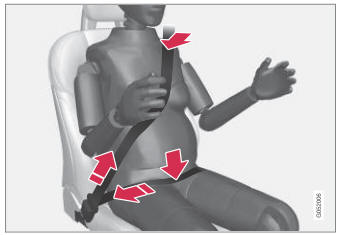
Safety during pregnancy
It is important that seat belts are worn correctly during pregnancy and that pregnant drivers adjust their seating position accordingly.
Seat belt