Volvo XC90: Wheels and tires / Changing a wheel
Wheel changes must always be carried out correctly. The following instructions show how to remove and install a wheel and what is important to keep in mind. Make sure that the tire dimension is approved for use on the vehicle.
WARNING
- If a tire must be changed near passing traffic, make sure all passengers move to a safe location.
- Use a jack intended for the vehicle when changing a tire. For any other job, use stands to support the vehicle.
- Never crawl under or allow any part of your body to be extended under a vehicle supported by a jack.
- Never let anyone remain in the vehicle when it is raised on a jack.
CAUTION
- When not in use, the jack* should be kept in its storage compartment under the cargo compartment floor.
- The jack provided with your vehicle is intended to be used only in temporary situations such as changing wheels in the event of a flat tire. Only the jack that came with your particular model should be used to lift the vehicle. If the vehicle needs to be lifted more frequently or for a prolonged period, using a garage jack or hoist is recommended. Always follow this device's instructions for use.
Removing a wheel
Read through all instructions before starting. Before raising the vehicle using a jack or lift, take out all the tools you will need.
- Turn on the vehicle's hazard warning flashers if a wheel change must be performed in an area with traffic.
- Make sure that the parking brake is engaged and put the gear selector in P position.
- Place chocks in front of and behind the wheels that are still on the ground. For example, use heavy wooden blocks or large stones.
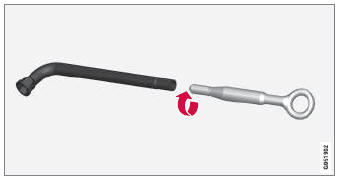
- Using the lug wrench, screw the towing eye into place as far as possible.
- Remove the plastic covers from the wheel bolts using the designated tool.
- With the vehicle still on the ground, use the lug wrench/towing eye to loosen the wheel bolts ½-1 turn by pressing downward (counterclockwise). Always start with the locking wheel bolts*.
- Follow the instructions for safely lifting the vehicle using a jack.
- Raise the vehicle until the wheel to be changed can move freely. Unscrew the wheel bolts and lift off the wheel.
Installing a wheel
- Clean the contact surfaces between the wheel and the wheel hub.
- Lift the wheel into place. Tighten the wheel bolts securely.
Do not grease the wheel bolt threads.
- Lower the vehicle so that the wheel cannot rotate.
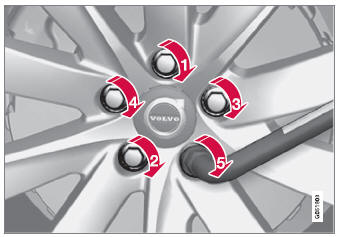
- Tighten the wheel bolts in a crisscross pattern (as shown in illustration).
It is important that the wheel bolts are securely tightened. Tighten to 140
Nm (103 ft. lbs.). Use a torque wrench to check torque.
- Press the plastic covers over the wheel bolts.
- Check the tire inflation pressure and store the new inflation pressure in the tire pressure monitoring system*.
WARNING
The wheel bolts may need to be tightened again several days after a wheel change. Temperature fluctuations and vibrations can cause them to loosen slightly.
NOTE
- After inflating a tire, always replace the valve cap to help prevent valve damage caused by gravel, dirt, etc.
- Use plastic valve caps only. Metal caps could corrode and become difficult to remove.
1 Tire Pressure Monitoring System (TPMS)
* Option/accessory.
 Tire inflation pressure monitoring system messages
(Option/accessory.)
A number of messages related to the tire inflation pressure monitoring system1
may be displayed. Several examples are provided below...
 Tool kit
Tools for e.g. towing or changing wheels are provided in the vehicle's cargo
compartment.
All the tools are located in a foam block under the cargo compartment
floor...
Other information:
Volvo XC90 2015-2026 Owners Manual: Driver Alert Control
The Driver Alert Control (DAC) function is designed to help alert the driver to erratic behavior, e.g. if the driver is distracted or showing signs of fatigue. The objective of the function is to detect slowly deteriorating driving behavior and is primarily intended to be used on major roads...
Volvo XC90 2015-2026 Owners Manual: Adjusting front seat cushion length
(Option/accessory) Depending on the selected equipment level, the length of the seat cushion can either be adjusted using the multifunction control* on the side of the seat cushion, or manually adjusted using the control on the front of the seat cushion...
- Manuals Home
- 2nd Generation XC90 Owners Manual
- 2nd Generation XC90 Service Manual
- Jump starting using another battery
- Resetting the trip odometer
- Video
- New on site
- Most important about car
Categories
Detachable towbar
(Option/accessory.)
Volvo recommends the use of Volvo towbars that are specially designed for the vehicle.
NOTE
The optional detachable trailer hitch may not be available in all markets or on all models. Consult your Volvo retailer.