
Volvo XC90: Safety / Folding down the integrated booster cushion
Option/accessory.
When the integrated booster cushion in the rear seat is not in use, it should be stowed (folded down).
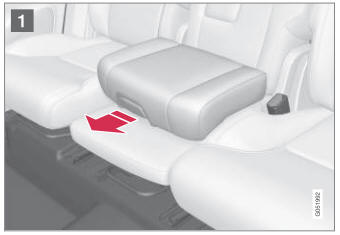
 Pull the handle forward to release
the booster cushion.
Pull the handle forward to release
the booster cushion.
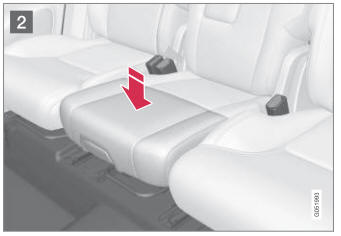
 Press down on the center of the
booster cushion to lock it into position.
Press down on the center of the
booster cushion to lock it into position.
CAUTION
Make sure that there are no objects (e.g. toys) on the seat under the integrated booster cushion before folding it down.
NOTE
The integrated booster cushion must be stowed (folded down) before folding down the seat backrest.
WARNING
DEATH or SERIOUS INJURY can occur
- Follow all instructions on this child restraint and in the vehicle's owner's manual.
- Make sure the booster cushion is securely locked before the child is seated.
- Only use for children who weigh between 15-36 kg (33-80 lbs) and who are between 97-137 cm (38-54 tum) in height. In Canada: 18 kg (40 lbs) is the minimum weight requirement for a child using booster cushions according to the Canadian regulation CMVSS 213.4
- Use only the vehicle's lap and shoulder belt system when restraining the child in this booster cushion.
- In the event of a collision while the integrated booster cushion was occupied, the entire booster cushion and seat belt must be replaced. The booster cushion should also be replaced if it is badly worn or damaged in any way. This work should be performed by a trained and qualified Volvo service technician only.
 Folding up the integrated booster cushion
Option/accessory.
When the integrated booster cushion is used, it must be folded up.
Pull the handle forward and upward
to release the booster cushion...

Other information:
Volvo XC90 2015-2026 Owners Manual: Bulb specifications
Specifications for replaceable light bulbs. If you are experiencing problems with any lights other than light bulbs, contact a workshop1. If there is a problem with an LED2 light, the entire lamp unit will normally need to be replaced. A Watt 1 An authorized Volvo workshop is recommended. 2 LED (Light Emitting Diode)..
Volvo XC90 2015-2026 Owners Manual: Activating and deactivating the heated rear seats
(Option/accessory) The seats can be heated for added comfort for the driver and passengers in cold weather. Activating and deactivating the heated rear seats from the front seats* Tap the symbol in the center of the climate bar to open Climate view in the center display. Select the Rear climate tab. Tap the seat heating button repeatedly to select one of the four levels: Off, High, Medi..
- Manuals Home
- 2nd Generation XC90 Owners Manual
- 2nd Generation XC90 Service Manual
- Drive modes
- Leveling control settings
- Connecting the vehicle to the Internet via vehicle modem (SIM card)
- New on site
- Most important about car
Categories
Apps
The App view contains apps that provide access to certain vehicle services.
Swipe the center display screen from right to left1 to access the App view from the Home view. This view displays downloaded apps (third-party apps) as well as apps for integrated functions, such as FM radio.
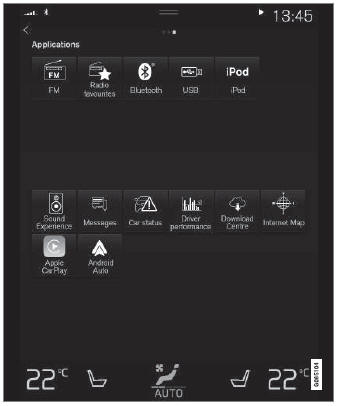
App view. (generic illustration; basic apps vary depending on market and model)
